The texts on this site are drafted with an AI, then reviewed and rewritten by me. At first, I rewrote a lot. The style did not come from a description of how I write, or from my old texts. It came from my corrections, turned into rules.
AI helps us go beyond our technical limits, as long as we work with it the way we would with a new colleague. This test has been running since October 2026; this article gives its starting point.
The hypothesis
To teach an AI a style, correcting what it writes works better than describing that style or giving it examples.
The test
Since October 2, 2026, every text on this site goes through a skill. It is a plain text file, stored with the site’s code, that the agent reads before writing. It describes how I write and gives examples. The home page, the article on the migration, the descriptions and the LinkedIn posts are written with it.
The loop has 4 steps:
- The agent writes a first draft from the skill.
- I rewrite the passages that don’t sound like me.
- The before/after pair is added to the skill, with the rule it reveals if that rule is new.
- The next text starts from the enriched skill.
For each text, I also note the share I rewrote and the number of rules added.
What the corrections taught
A style description stays vague. The AI reads “direct” or “no jargon” and keeps writing as before. My old texts didn’t help either, since the one on the old site had itself been written by an AI.
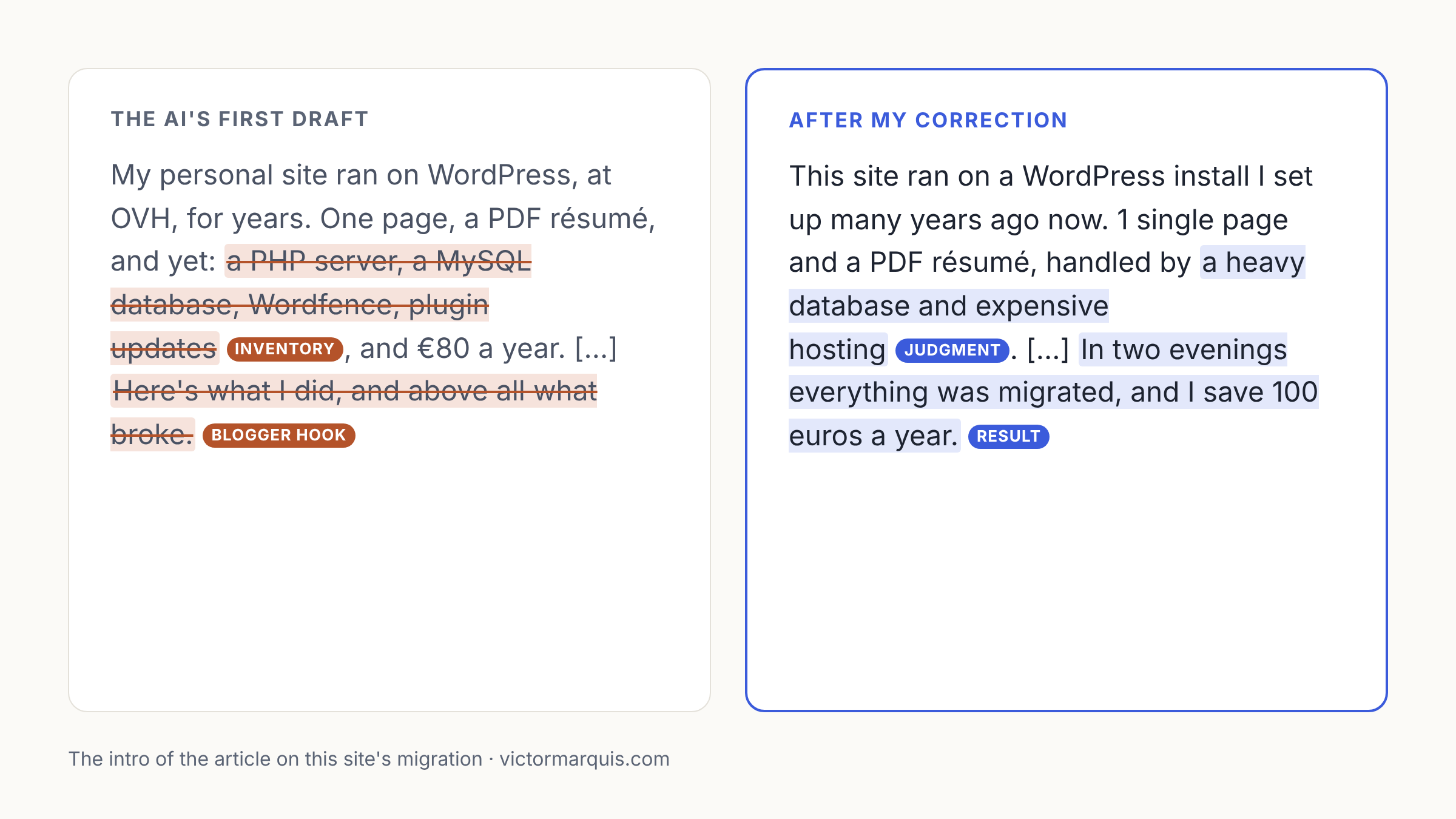
Corrections show the problem in a real sentence. For the article on the migration, the AI started with an inventory:
One page, a PDF résumé, and yet: a PHP server, a MySQL database, Wordfence, plugin updates, and €80 a year. […] Here’s what I did, and above all what broke.
My version judges instead of listing, and gives the result right away:
1 single page and a PDF résumé, handled by a heavy database and expensive hosting. […] In two evenings everything was migrated, and I save 100 euros a year.
2 rules came out of it: judge rather than list, and no blogger hooks.
Another correction was about facts. On the home page, the AI had given me a bigger role than my real one:
Shipping without waiting for engineers. I ship fixes and prototypes myself […], then sign off on every release.
I don’t sign off on every release. The published version says “Contributing to the code” and talks about “minor changes”. The skill gained a rule: never give me a role or an action that hasn’t been confirmed. An AI writing on your behalf tends to embellish you, so check the facts too, not just the style.
The correction that comes back most often is about mirrored sentences. To present Glowtify, the AI had written “The customer talks to the app, the app does the work.” My version starts from the user and goes all the way to the effect: “Users describe their intent in the app, whether it is strategy, a campaign, content or analysis. The right agent takes over.”
Today, the skill has 14 rules, a list of tics to avoid and 5 before/after examples. According to the skill’s history, 10 of these rules come directly from a rewrite. The other 4 are working instructions, such as keeping the same figures in French and English. The very first version, with its first 8 rules, was even written from a single correction: the rewrite of the migration intro.
The starting point
The first text tracked is a LinkedIn post, written on October 18, 2026. I rewrote its whole substance: the AI’s version gave a lesson, while I wanted to share an experience. That correction produced an entire section of the skill, dedicated to posts.
A first signal comes from the skill’s history. It was changed 5 times on the day it was created, while the site was being built, then once on October 14 and once on October 18: corrections cluster at the start. That is encouraging, but too early to conclude.
This is point zero. If the hypothesis holds, the share I rewrite drops from one text to the next, and new rules become rarer.
What I take from it
As often with AI, what works best is to reproduce a human way of working rather than trying to automate everything at once. You don’t teach a new colleague your style by sending them a style sheet. You give them context, then correct their first texts with them.
To get an agent to write like you, the method has 4 steps:
- Start with a short description of your style. A few lines are enough: it gives context, not the style.
- Keep every correction, with the passage before and after.
- Only write a rule when a correction comes back. A one-off correction stays an example.
- Reread the skill from time to time and remove rules that contradict each other. As you keep adding them, some end up getting in each other’s way.
The parallel with Glowtify
Glowtify’s agents write for companies that each have their own voice. At Glowtify, we reach the same conclusion: describing your tone to an AI is not enough, you have to show it something concrete, and user corrections are the most promising lead.
The limits
This test covers a single person and a handful of texts. The figures will give indications, not proof.
What’s next
Every text written with the skill is tracked. The next check-in, in early December 2026, will show how the rewritten share evolves.